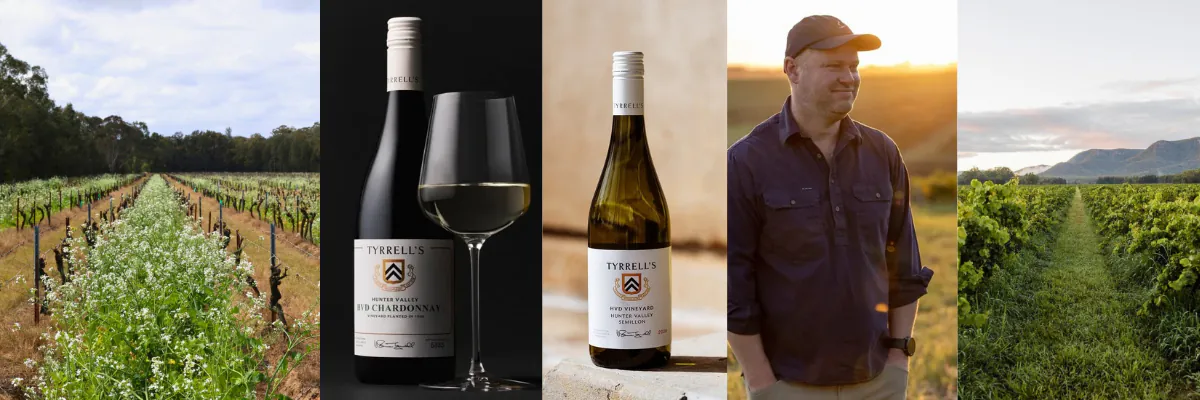
In 2028, Tyrrell’s will celebrate 170 years, while the Hunter Valley marks 200 years of continuous grape growing — a milestone that reinforces the Hunter’s place as Australia’s oldest continuously cultivated wine region.
For Tyrrell’s, those numbers are not simply anniversaries. They are the foundation of the way the family farms, makes wine and thinks about its place in the world.
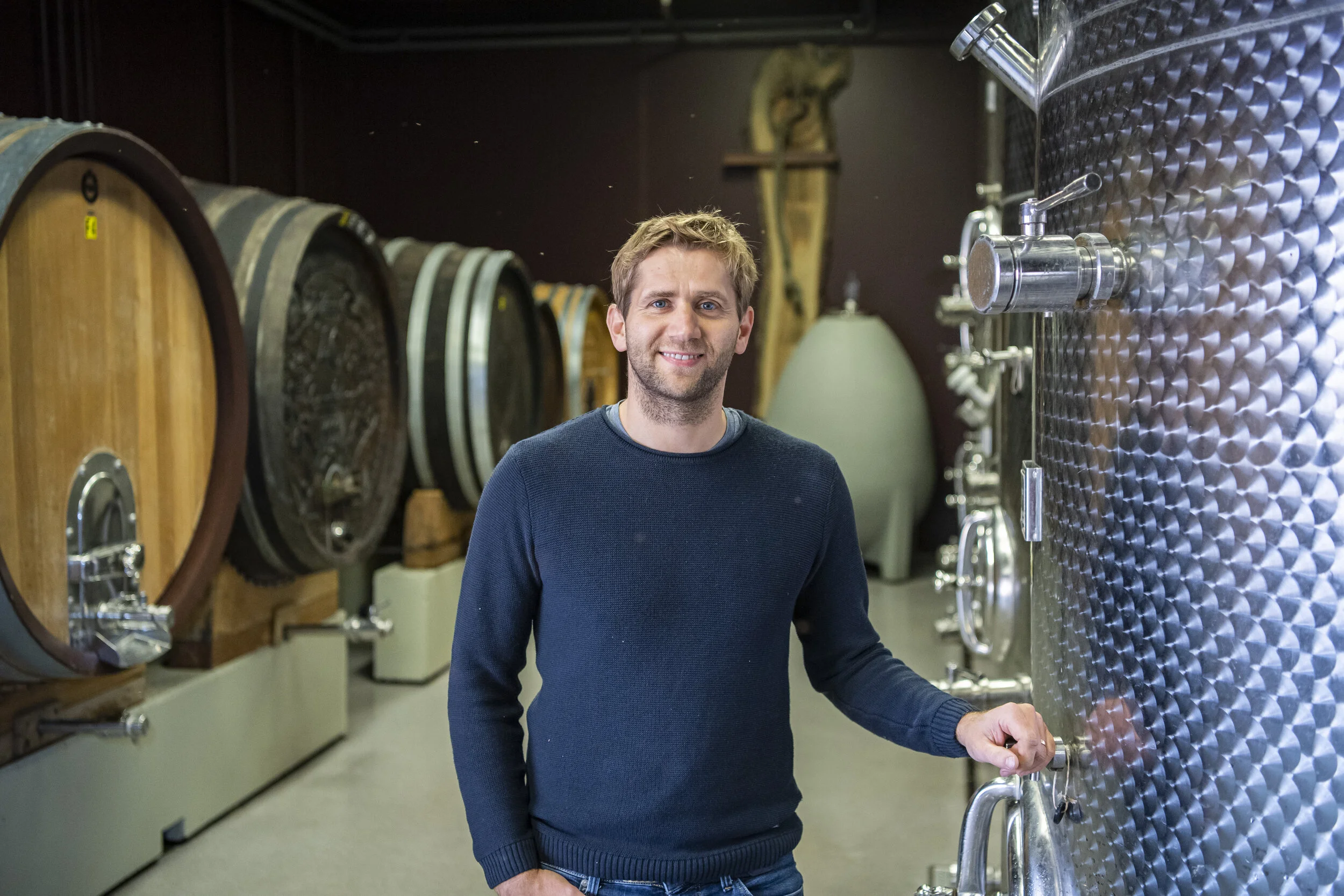
Today, fifth-generation family member Chris Tyrrell is quick to point out that the real story is not longevity for longevity’s sake.
It is what that longevity has preserved.
A Winery That Still Does the Work Itself
Tyrrell’s owns roughly 300 acres of vines and works with only a small group of local growers, many through relationships that have lasted generations. Not contracts. Handshakes. The winery also keeps an unusually large amount of vineyard work in-house.
“We run our own pruning crews, run our own picking crews,” Chris says. “There’s never contractors coming to our place.”
That makes Tyrrell’s relatively “heavy in a staff sense,” as Chris puts it, but deliberately so. “We like to do everything ourselves.”
That philosophy gives Tyrrell’s an unusually close relationship with its vineyards, from pruning through harvest, and reflects a family business that still believes the details matter.
The Old-Vine Advantage
The Hunter Valley was never affected by phylloxera, and that accident of history has left Tyrrell’s with access to some extraordinary viticultural material.
Many of the region’s historic vineyards were planted before phylloxera devastated large areas of Europe, and many remain on their own roots. For Chris, that detail is just as important as vine age itself.
“The original genetic material is here.”
Australia is home to some of the world’s oldest surviving vineyards of major varieties, including Semillon, Chardonnay, Shiraz, Grenache and Cabernet Sauvignon.
At Tyrrell’s, that legacy is not simply absorbed into larger blends. The winery now produces single-vineyard wines from 10 vineyards more than 100 years old. Chris puts the question plainly:
“I’m not sure if there’s another winery in the world that has as many individual bottlings of 100-plus-year-old vineyards as single-vineyard wines.”
It is an extraordinary point of difference: not simply old-vine wine, but site-specific wine from century-old vineyards, bottled to preserve the identity of individual places.
HVD: A Vineyard With Few Peers
One of the clearest examples is HVD — Hunter Valley Distillery.
The vineyard was planted in 1908, originally to produce grapes for distillation. Today, its Chardonnay block is described by Tyrrell’s as the oldest Chardonnay vineyard in the world. Penfolds owned the vineyard for decades before Tyrrell’s acquired it in 1982. The site now plays an important role across the range, both through the single-vineyard HVD wines and as a source of fruit for broader Hunter Valley bottlings.
What makes HVD especially compelling is the combination of age, pedigree and consistency.
Old-vine wines are often tiny-production curiosities. HVD is different. It offers a genuine old-vine story while remaining one of Tyrrell’s most recognizable and enduring wines. As Chris puts it, having a wine from a vineyard of that age at its price point is “pretty good.”
That may be Australian understatement.
Murray Tyrrell and the Fine Wine Path
If the old vineyards are the backbone of Tyrrell’s, Murray Tyrrell helped define what the family would do with them.
In the 1960s, Murray became fascinated by fine wine at a time when Australia’s table-wine culture looked very different from today.
His introduction to white Burgundy became a turning point.
After discovering that the grape was Chardonnay, Murray became determined to experiment with the variety himself. At the time, Chardonnay was still scarcely planted in Australia, but Murray managed to source material and establish vines at Tyrrell’s.
The 1971 vintage became Australia’s first commercially released, varietally labeled Chardonnay, establishing Tyrrell’s as a pioneer of the variety in Australia. Murray also pushed further into French oak and barrel selection at a time when such practices were far from standard.
“He was just a pretty adventurous guy,” Chris says. More importantly, it established the philosophy that still guides the winery. “He set us on this path that we’re on today about fine wine.”
Then comes the line that perhaps best summarizes Tyrrell’s: “A lot of people talk fine wine but don’t always walk the walk.”
Tyrrell’s intends to do both.
Vat 1, Vat 47 and Vat 9
Today, the core of that fine-wine philosophy is expressed through Tyrrell’s Winemaker’s Selection wines:
Vat 1 Semillon
Vat 47 Chardonnay
Vat 9 Shiraz
These are among the winery’s most important bottlings and sit alongside the tiny-production Sacred Sites wines and the estate’s broader single-vineyard collection.
But Chris makes an interesting admission.
The great vineyards can sometimes make the winemaker’s job relatively straightforward. Speaking about wines such as Vat 1 and HVD, he says:
“They’re like the easiest wines you make, because the vineyards are so good.” The harder work can come further down the range. “When you’re blending vineyards, working with growers — that Tyrrell’s range, that’s where we really work hard.”
It is an important insight into how Tyrrell’s views its portfolio. The Hunter Valley Semillon, Chardonnay and Shiraz are not afterthoughts beneath the flagship wines. They are wines the family expects to over-deliver.
Hunter Valley Semillon: Purity Over Complexity
Few wines offer quite the same combination of regional identity, refreshment and ageability as Hunter Valley Semillon.
Tyrrell’s Hunter Valley Semillon is made using the same fundamental winemaking approach as Vat 1. The difference comes primarily from site, vine age and harvesting. Chris notes that the current blend draws heavily from HVD and Army Block, two neighboring
vineyards with strong pedigree.
The goal is straightforward: “Pure classic Hunter Sem.”
That phrase says a great deal about Tyrrell’s approach. The aim is not to embellish the wine, but to preserve what makes Hunter Valley Semillon distinctive in the first place: freshness, low alcohol, clarity and the ability to evolve dramatically in bottle.
Young Hunter Semillon can be bright and direct. With age, it develops the complexity that has made the style one of Australia’s most distinctive contributions to the world of wine.
Australian Shiraz — Just Not the Shiraz You Expect
Tyrrell’s Hunter Valley Shiraz presents an equally compelling counterpoint to familiar assumptions about Australian red wine.
For anyone who still associates Australian Shiraz with high alcohol, heavy oak and dense fruit, the Hunter can come as a surprise.
Tyrrell’s style is generally more medium-bodied, acid-driven and savory.
Chris describes the wines in terms of bright red fruit, spice, freshness and softer tannins. Large-format oak helps preserve that character rather than covering it. The result sits far from the stereotype of Australian Shiraz.
It is fresher, more restrained and more transparent, with acidity forming the backbone of the wine rather than sheer weight.
In that sense, Hunter Valley Shiraz has its own identity entirely — one rooted in place rather than expectation.
“The Best Midweek Wine of All Time”
Chris has an equally useful way of describing the Hunter Valley Shiraz.
“The best midweek wine of all time.”
Then he improves it:
“The best pizza wine ever.”
It sounds casual, but the point is serious.
The ambition is not to make a wine that demands contemplation before every sip. It is to make a genuinely high-quality wine that people actually want to drink.
That philosophy carries through to release decisions as well.
Tyrrell’s is comfortable holding red wines back rather than rushing them into market simply because a new vintage is available.
As Chris says, ultimately, “someone’s going to go and take this thing to dinner and drink it.”
For a producer with nearly 170 years of history, it is an admirably uncomplicated benchmark.
History You Can Actually Drink
Tyrrell’s has no shortage of impressive numbers.
Nearly 170 years as a family business.
Two centuries of continuous grape growing in the Hunter Valley.
Vineyards planted more than a century ago.
Some of the oldest Chardonnay and Semillon vines in the world.
Ten individual wines sourced from vineyards more than 100 years old.
But the significance of Tyrrell’s lies in the fact that these are not museum pieces.
They are living vineyards producing wines that remain relevant, distinctive and unmistakably connected to place.
From Vat 1 and Vat 47 to HVD, Hunter Valley Semillon and Hunter Valley Shiraz, the same philosophy runs through the range: preserve the vineyard, avoid unnecessary intervention, and make wines that taste unmistakably of the Hunter.
Tyrrell’s may have nearly 170 years behind it.
The more interesting story is how alive those 170 years still feel today.