In 2026, Broadbent Selections celebrates 30 years of championing wines of place, history, and character. To mark the occasion, the Broadbent team traveled through Portugal, visiting regions and producers that have helped shape both the company’s portfolio and its point of view.
The journey began in Porto and Vila Nova de Gaia, moved into the Douro Valley and Vinho Verde, and concluded on the island of Madeira. Along the way, the trip brought together long-standing partners, historic wine families, dramatic vineyard landscapes, and some of Portugal’s most distinctive wine traditions.
More than an anniversary celebration, it was a chance to revisit the foundations of what Broadbent Selections has always valued: authenticity, regional identity, long-term relationships, and wines that reward curiosity.
Porto and Vila Nova de Gaia: At the Heart of Port
The celebration began in Vila Nova de Gaia, across the Douro River from Porto, where the Port lodges have long formed the commercial and cultural heart of the category. Though the grapes come from the Douro Valley upstream, Gaia has historically been the place where Port is aged, blended, bottled, shipped, and shared with the world.
That separation between vineyard and lodge is part of what makes Port so fascinating. The Douro gives the wine its raw material: schist soils, steep terraces, heat, structure, and intensity. Gaia gives it time, refinement, and identity. House style is not accidental. It is built through blending, cask selection, maturation, and generations of accumulated judgment.
The opening dinner at Taberninha Do Manel brought together Broadbent Selections with friends and partners from Sogrape, Churchill’s, and the broader Port community, including Sergio Silva of Sogrape, Johnny Graham and Ben Himowitz of Churchill’s, and Roy Hersh of ForTheLoveOfPort.com.
It was a fitting beginning: a room filled with people whose work is rooted in Portuguese wine, gathered in the place where so much of that history still feels alive.
Quinta da Gricha: The Douro in Detail
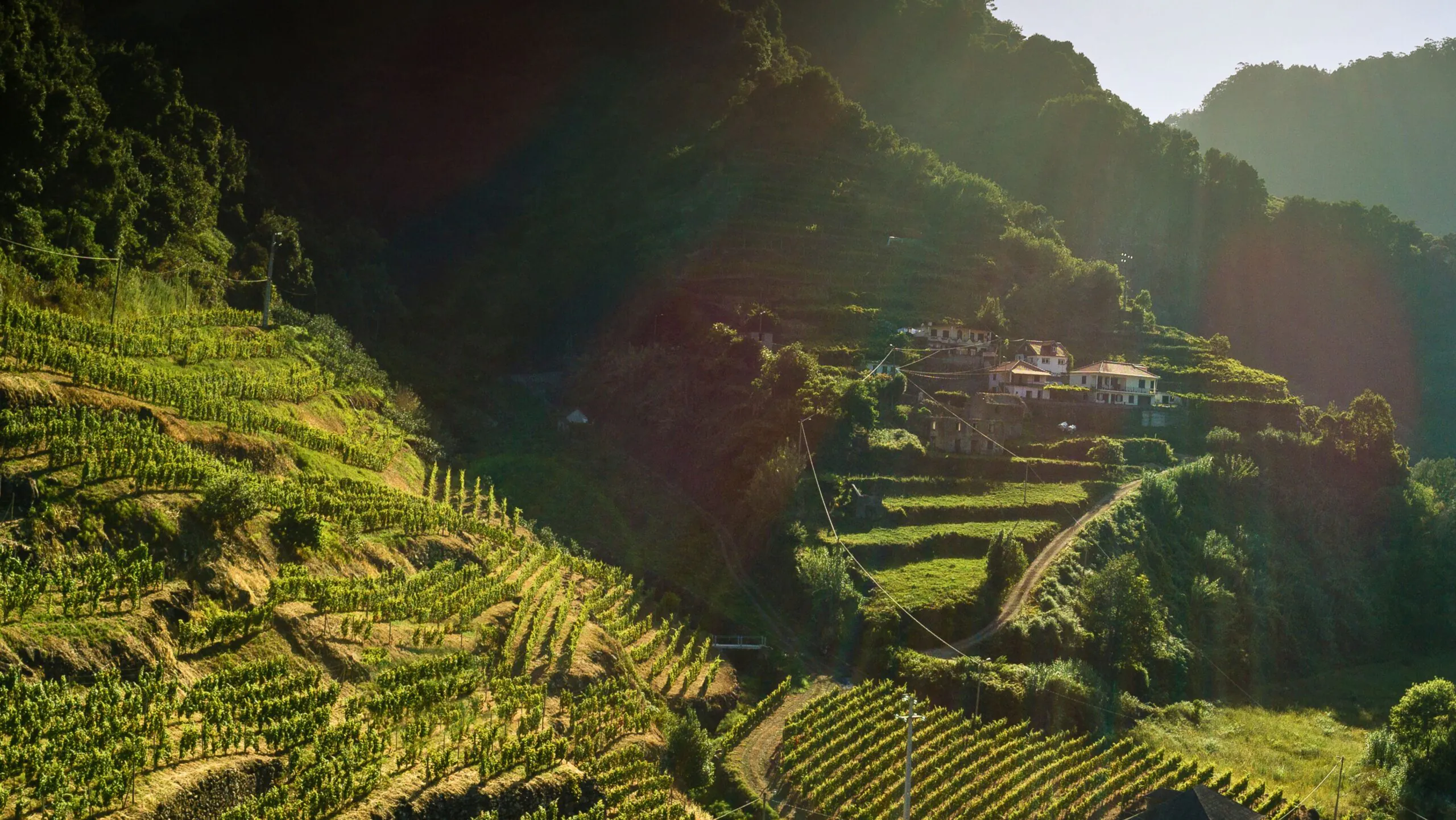
The next morning, the group traveled into the Douro Valley for a visit to Quinta da Gricha, Churchill’s estate. The Douro is one of the most visually spectacular wine regions in the world, but its beauty is inseparable from its difficulty.
This is mountain viticulture. Vines are planted on steep slopes, often on terraces carved into schist. Water is scarce, summer heat can be extreme, and yields are naturally low. Many vineyards are planted as field blends, with multiple indigenous varieties growing together in old parcels rather than neatly separated by grape.
That complexity shows in the wines. Touriga Nacional may bring perfume and structure, Touriga Franca generosity and floral lift, Tinta Roriz spice and firmness, Tinta Barroca flesh, and Tinto Cão acidity and longevity — but in the Douro, the vineyard often speaks as much through the blend as through any individual variety.
At Quinta da Gricha, the visit included a guided tour of the property followed by a traditional Douro lunch paired with Churchill’s wines.
The experience offered a close look at a producer whose identity is tied to both heritage and independence. Churchill’s has long occupied a distinctive place in the Port world, balancing classic structure with freshness, precision, and a clear sense of estate character.
Seeing the Douro from the River
After lunch, the group traveled by private boat along the Douro from Quinta da Gricha to Pinhão.
There may be no better way to understand the region’s geography. From the river, the vineyards appear almost vertical, rising in layers above the water. The landscape makes clear why the Douro has always required patience, labor, and ingenuity.
The river also tells the story of Port’s movement from vineyard to world market. Historically, wine traveled downriver toward Porto and Vila Nova de Gaia, linking remote inland vineyards with merchants, lodges, and export markets. The Douro River was not simply scenery. It was the region’s spine.
That sense of movement — from vineyard, to river, to lodge, to table — remains central to the identity of Port.
Vinho Verde at Quinta de Azevedo
From the Douro, the group continued to Quinta de Azevedo for an immersion into Vinho Verde with Sogrape. The visit included a regional introduction, vineyard and winery tour with the winemaking team, a tasting, and dinner hosted by the Guedes family.
Vinho Verde is often described in shorthand as light, fresh, and gently spritzy. While that can be true, the region is far more nuanced than the stereotype suggests.
Its Atlantic influence, rainfall, granitic soils, and naturally high-acid varieties create wines defined by energy and clarity. Grapes such as Loureiro, Alvarinho, Arinto, Avesso, and Trajadura each bring something different: citrus, floral aromatics, salinity, texture, orchard fruit, or mineral tension.
The best examples are not simply refreshing. They are precise. They depend on timing: picking early enough to preserve acidity, but late enough to develop flavor. They depend on careful handling in the cellar: clean fermentation, protection of aromatics, and thoughtful use of lees or texture when appropriate.
At Quinta de Azevedo, Vinho Verde came into focus not as a simple category, but as one of Portugal’s most dynamic expressions of freshness, place, and technical finesse.
Sogrape and the Scope of Portuguese Wine
The following morning began with a visit to Sogrape’s Avintes facilities.
Sogrape holds an important place in Portugal’s modern wine story. Its reach is broad, but its strength lies in the ability to connect scale with regional identity. Portuguese wine is unusually diverse for a country of its size, and producers like Sogrape play a key role in bringing that diversity into focus.
A visit to Avintes highlights the less romantic but essential side of wine: precision, consistency, research, logistics, quality control, and the ability to support wines from vineyard to bottle at a high level. These details are often invisible in the glass, but they shape the reliability and clarity of the final wine.
Portugal’s great strength is not a single grape, style, or region. It is the interplay between many local identities. Seeing Sogrape’s work up close offered a reminder of how much expertise is required to preserve those identities while bringing them to a wider audience.
The Factory House and Churchill’s Lodge
Lunch at The Factory House was one of the most historically resonant moments of the trip – an incredibly important invitation – The Factory House is a prestigious club connected to original English Port shippers.
That history is central to understanding Port. Few wines are as deeply shaped by international exchange. Port is Portuguese by origin, rooted in the Douro’s vineyards, but its development was profoundly influenced by British merchants, shipping networks, and export markets.
The Factory House stands as a living reminder of that relationship. It is not just a historic building; it is part of the cultural architecture of Port.
The afternoon continued at Churchill’s Lodge for a guided tour and tasting.
In the lodge, Port becomes a study in time and blending. Fruit, tannin, sweetness, spirit, oxidation, cask influence, and freshness must all find balance. Vintage Port, Late Bottled Vintage, Tawny, and other styles each ask different questions of the cellar. Some emphasize the power and individuality of a year; others depend on long maturation and the quiet complexity of oxidative aging.
What unites them is patience. Port is not simply made; it is raised.
Madeira: Wine Shaped by Island, Heat, and Time
After Porto, the group flew to Madeira, shifting from the steep schist terraces of the Douro to a volcanic Atlantic island with one of the world’s most singular wine traditions.
Madeira is a wine category unlike almost any other. It is fortified, deliberately exposed to heat and oxygen, and capable of extraordinary longevity. Where most wines are protected from heat and oxidation, Madeira is transformed by them.
That transformation can happen through estufagem, where wine is gently heated in controlled conditions, or through canteiro, where casks age slowly in warm lofts over many years. The result is a wine of remarkable stability, layered with acidity, concentration, savory complexity, dried fruit, citrus peel, spice, nuts, caramelized tones, and often a saline edge that recalls the island itself.
The grape varieties each tell a different story. Sercial tends toward the driest, most incisive style. Verdelho brings medium-dry texture and lift. Bual often combines richness with balancing acidity. Malmsey offers the sweetest and most opulent expression. Tinta Negra, long underestimated, has become increasingly important in understanding Madeira’s everyday versatility and historic breadth.
Over several days, the group explored the island’s dramatic geography, from coastal viewpoints and fishing villages to mountain passes and volcanic landscapes. Stops included Pico da Torre, Cabo Girão, Fajã dos Padres, Ponta do Sol, Porto Moniz, Véu da Noiva, Encumeada, Cristo Rei, Machico Bay, Porto da Cruz, Santana, Pico do Arieiro, and Eira do Serrado.
The island matters because Madeira wine cannot be separated from Madeira itself. The vineyards, climate, humidity, slopes, maritime history, and long shipping tradition all help explain why this wine developed the way it did.
Justino’s Madeira and the Broadbent Connection
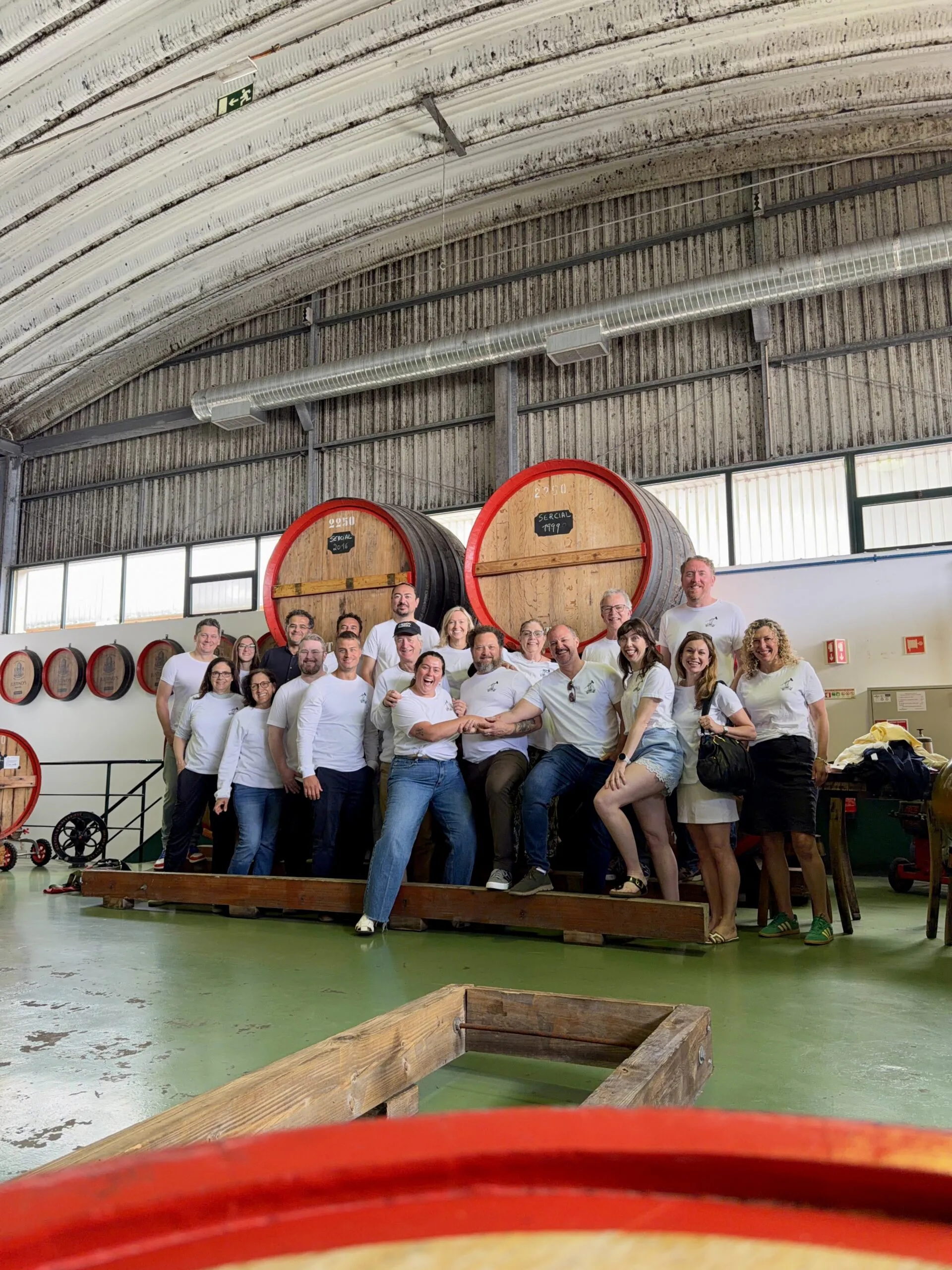
The visit to Justino’s Madeira / Broadbent was one of the most meaningful stops of the trip. The group toured the winery, tasted, and continued the day with a traditional lunch at Restaurante Viola.
Madeira has always held a special place in the Broadbent story. It is a category that requires explanation, but rewards it generously. Few wines combine history, durability, complexity, and value in quite the same way.
A bottle of Madeira can remain open for weeks or months without losing its character. It can pair with dishes that challenge other wines: consommé, mushrooms, aged cheeses, nuts, caramelized desserts, chocolate, foie gras, or simply a quiet moment after dinner. Its acidity gives it lift; its aging gives it depth; its structure gives it nearly unmatched resilience.
At Justino’s, those qualities became tangible. The visit connected the technical side of Madeira production with the emotional side of a long partnership: the barrels, the heat, the patience, the blending, and the continued belief in one of the world’s great historic wine categories.
Food, Poncha, and the Island Table
The Madeira itinerary also included traditional restaurants, local dishes, and poncha, the island’s beloved drink made with sugar cane spirit, citrus, and honey.
These experiences were more than scenic additions. They placed the wines within their natural cultural setting. Madeira’s piercing acidity, savory depth, and oxidative complexity make even more sense alongside island flavors: seafood, espetada, tropical fruit, garlic, herbs, smoke, and sweetness.
Wine is always more complete when understood at the table. In Madeira, the table is generous, local, and deeply tied to the island’s terrain.
Thirty Years, and Still Rooted in Place
The Broadbent Selections 30th anniversary trip was a celebration, but it was also a return to fundamentals.
In Porto and Gaia, the group revisited the history of Port and the lodge culture that shaped it. In the Douro, they saw the demanding vineyard work behind the wines. In Vinho Verde, they explored freshness, precision, and Atlantic identity. In Madeira, they encountered one of the wine world’s most original expressions of time, heat, and place.
Together, these experiences reflected what has guided Broadbent Selections for three decades: relationships built over time, wines with a clear sense of origin, and producers whose stories are worth telling.
Thirty years on, the mission remains the same — to champion wines that are not only delicious, but meaningful.